ITR Filing 2026: Documents Required, Team Management & CA Office Workflow
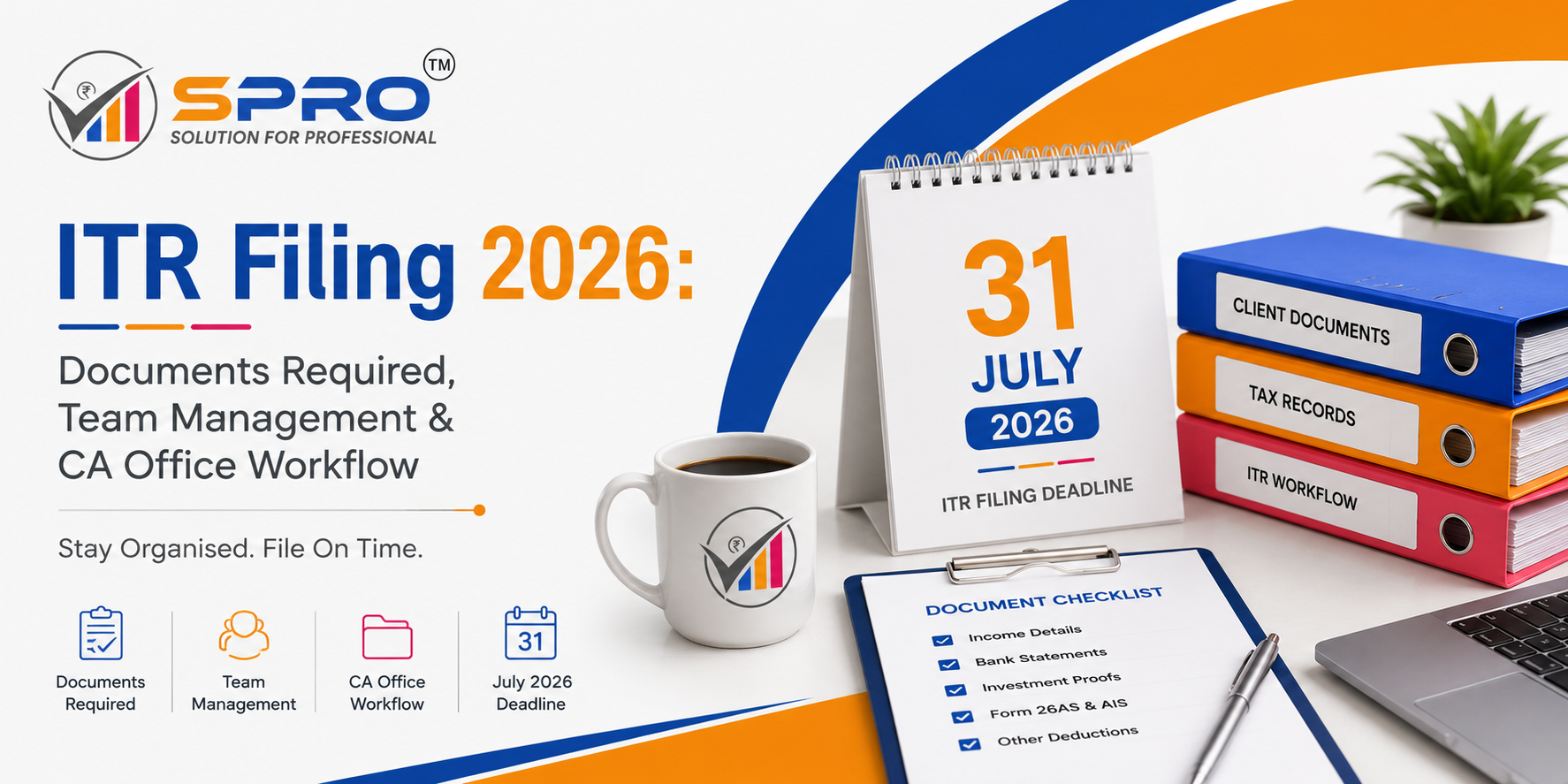
ITR Filing 2026: Documents Required, Team Management & CA Office Workflow
The 31 July 2026 deadline for filing Income Tax Returns is one of the busiest periods for Chartered Accountants and tax professionals across India. As the filing season progresses, firms must manage multiple client engagements simultaneously while ensuring compliance with statutory deadlines. Although tax computation is a critical part of the process, the efficiency of the filing season largely depends on timely document collection, structured task allocation, seamless team coordination and effective workflow management. Firms handling a growing client base often find that operational efficiency has a greater impact on turnaround time than the complexity of the return itself. Establishing a systematic process before the deadline helps reduce last-minute follow-ups, improve accuracy and deliver a better client experience. Taxpayers and professionals should also keep track of the latest notifications, filing utilities and due dates published on the official Income Tax e-Filing Portal.
Complete Client Document Checklist
Preparing an accurate Income Tax Return begins with collecting complete financial information from the client. Missing or incorrect documents can delay computation, increase review time and lead to unnecessary revisions. Before initiating the filing process for FY 2025–26 (AY 2026–27), ensure that the following documents are available.
Income & Employment
• Form 16 / Salary Slips
• Income Proof for Business / Profession
• Dividend / Gift / Any Other Sources of Income
• Foreign Income Details (if applicable)
Banking & Financial Records
• Bank Statements (All Accounts)
• Interest Certificates for Deposits and Loans
• Capital Gain Statements
• Sale Details of Property, Gold or Other Assets
• Rental Income / Other Property Income Details
Tax & Investment Records
• Investment Proofs
• Mediclaim Premium Details
• Any Other Allowable Deductions Proof
• Form 26AS
• Annual Information Statement (AIS)
• Taxpayer Information Summary (TIS)
Along with client-provided documents, tax professionals should reconcile financial information using Form 26AS, review the Annual Information Statement (AIS) and compare it with the Taxpayer Information Summary (TIS) before finalising the return. This verification helps identify mismatches in income reporting, TDS credits and high-value financial transactions at an early stage, reducing the possibility of return revisions or notices.
Managing the Filing Season Efficiently
For most CA firms, the challenge during ITR season is not limited to preparing returns. The larger operational challenge lies in coordinating hundreds of client engagements that are all moving through different stages of the filing process. Client documents are received through emails, WhatsApp, cloud drives and physical files, making it difficult to maintain a single source of information. Staff members spend considerable time following up for pending documents, verifying whether the latest versions have been received and tracking the status of individual assignments.
As the filing deadline approaches, partners require visibility into pending work, managers need to distribute assignments across teams and administrative staff must ensure that acknowledgements, invoices and client communication are completed without delay. When these activities are managed through spreadsheets, manual registers or multiple communication platforms, workflow visibility is significantly reduced. This often results in duplicated efforts, delayed reviews and unnecessary pressure during the final weeks before the filing deadline.
Collecting documents early certainly helps, but it represents only the first stage of the compliance process. Every return still passes through document verification, tax computation, internal review, client approval, Digital Signature Certificate (DSC) application where required, return filing, acknowledgement sharing and billing. Any delay in one stage directly impacts the next. Without a structured workflow, firms may receive all the necessary documents on time yet continue to experience operational bottlenecks because tasks, responsibilities and pending activities are not centrally monitored.
Streamlining the Workflow with Practice Management Software
Many CA firms are addressing these operational challenges by adopting practice management software that centralises their day-to-day operations. Instead of managing clients through disconnected spreadsheets, emails and messaging applications, firms can monitor every engagement from a single platform while improving collaboration across teams.
SPRO Practice Management Software is designed specifically for Chartered Accountants and professional firms to simplify compliance operations throughout the filing season. Its Task Management Module enables firms to assign work, define priorities, monitor progress and ensure that every return moves through the filing lifecycle without losing visibility. The Document Management Module provides a secure repository for client records, ensuring that Form 16, bank statements, investment proofs, AIS, Form 26AS and supporting documents remain organised and easily accessible to authorised team members.
In addition, SPRO supports Receipt-Based Billing, allowing firms to manage billing alongside compliance work rather than after the filing season has ended. Its DSC Management Features help monitor Digital Signature Certificate validity, renewal schedules and client mappings from a central location, reducing delays caused by expired certificates or manual tracking.
By integrating these operational functions into a single workflow, firms can reduce administrative effort, improve turnaround time and allow professionals to focus on delivering accurate tax advisory and compliance services instead of spending valuable time coordinating routine activities.
Conclusion
A successful ITR filing season depends on much more than accurate tax computation. Complete documentation, structured workflows, clear task ownership and efficient operational management play an equally important role in ensuring timely and error-free filing. As the 31 July 2026 deadline approaches, taxpayers should prioritize submitting complete documentation at the earliest opportunity, while CA firms should evaluate whether their internal processes can efficiently support the volume of work during the filing season. A well-managed workflow not only improves productivity and client satisfaction but also creates a scalable foundation for future compliance cycles.